What Is Digital Shelf Management and Why Is It Important for Brands? The Complete Guide to Digital Shelf Management for Consumer Brands
Digital shelf management is the ongoing practice of monitoring, optimizing, and distributing your brand's product content across every digital channel where shoppers can find and buy your products. For brands selling through retailers, marketplaces, and their own websites, it's the operational discipline that determines whether your products are visible, accurate, and compelling — everywhere they appear.
Walk into any physical store and you immediately understand the battle for shelf space. Is your product at eye level? Is the packaging clean and clearly labeled? Is it next to the right competitors — or the wrong ones? Brands have spent decades mastering the science of the physical shelf. Now, that same battle has moved online — and the stakes are higher, because you can't see exactly where you stand.
Search algorithms, product content quality, and customer reviews all shape whether shoppers find you, and they shift constantly. Whether a shopper is browsing Amazon, searching Google, scanning a retailer's app, or asking an AI assistant what to buy, your brand's presence — or absence — determines whether you win or lose the sale.
In this guide, we'll break down exactly what digital shelf management means, what a winning strategy looks like, and how brands are using AI and smart content operations to stay ahead.
Here's what you can expect to find in this article:
What Is Digital Shelf Management and Why Is It Important for Brands?
How to Build a Digital Shelf Management Strategy for Consumer Goods
Digital Shelf Management Best Practices: Optimizing Product Listings Across Channels
How to Improve Digital Shelf Management and Product Visibility
Use Case: How BSH Got Product Information to Shoppers, Faster and More Accurately
Benefits of Using AI in Digital Shelf Management
Where to Find Digital Shelf Management Platforms for Ecommerce
Frequently Asked Questions
What Is Digital Shelf Management and Why Is It Important for Brands?
The digital shelf is the online equivalent of a physical product display: every place a consumer can discover, evaluate, and purchase your product in a digital environment. This includes retailer product pages (Amazon, Walmart, Target, Kroger), brand websites, search engine results pages, social commerce platforms like Instagram Shopping and TikTok Shop, AI-powered shopping assistants, and comparison sites and review aggregators.
Unlike a physical shelf, the digital shelf is not a single location — it's everywhere and nowhere at once. A shopper might discover your product through a Google search, compare it on a retailer's site, read reviews on a third-party aggregator, and complete the purchase in a mobile app. At every step, the quality of your digital shelf presence shapes their decision.
The stakes are high. 98% of consumers research products before buying, with the majority doing so online, and shoppers rarely look beyond the first page of search results on any platform. On top of that, AI tools like Google’s shopping features and ChatGPT are increasingly helping shoppers decide what to buy before they even visit a retailer’s website — meaning if your brand isn’t showing up in those results, you’ve already lost the sale.
The digital shelf isn't a complement to physical retail anymore. For most product categories, it is the retail experience.
What Is Digital Shelf Management?
Digital shelf management is the end-to-end discipline of monitoring, optimizing, and governing your brand's presence across every digital channel where your products appear. It encompasses everything from creating and distributing product content, to tracking performance metrics, to responding to competitive changes in real time.
It's the operational system that keeps your digital shelf healthy. Without it, brands face:
Product inaccuracy — product descriptions, images, specs, or attributes that become outdated or inconsistent across retailers
Blind spots — no visibility into how products actually appear to shoppers on third-party platforms
Reactive decision-making — discovering problems only after they've already hurt sales
Inefficiency — content teams manually updating listings one retailer at a time, at scale
Digital shelf management replaces all of this with a proactive, centralized, data-driven approach. It's not a one-time project. It's an ongoing operational discipline — and the brands that treat it as such consistently outperform those that don't.
The Building Blocks of Digital Shelf Content
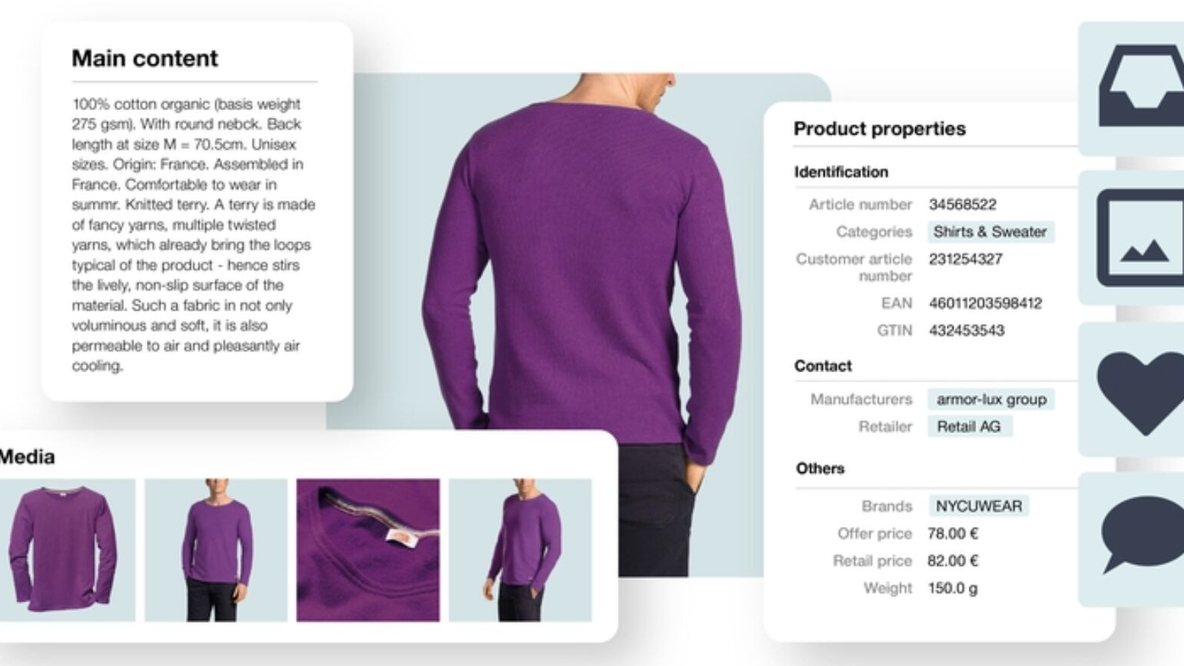
At the core of digital shelf management is your product content and data: every piece of information about your products that appears online. This includes product data (specifications, dimensions, ingredients, certifications) and product content (titles, descriptions, bullet points, images, lifestyle photography, 360° views, video, A+ pages, brand stores, and user-generated content like reviews and Q&A)
How complete and accurate your product data is directly influences how retailers rank your products in search. How compelling your product content is directly influences whether shoppers buy. Both are only as good as the systems and processes behind them.
Censhare's product view — product content and data together in a single interface.
How to Build a Digital Shelf Management Strategy for Consumer Goods
A digital shelf strategy is your brand's plan for winning visibility, relevance, and conversions across digital commerce channels. For consumer goods brands especially, the complexity is real: products may appear across hundreds of retailer sites, with different data requirements, different competitive contexts, and different shopper behaviors.
A mature strategy rests on five pillars:
Pillar 1: A Single Source of Truth for Product Content and Data
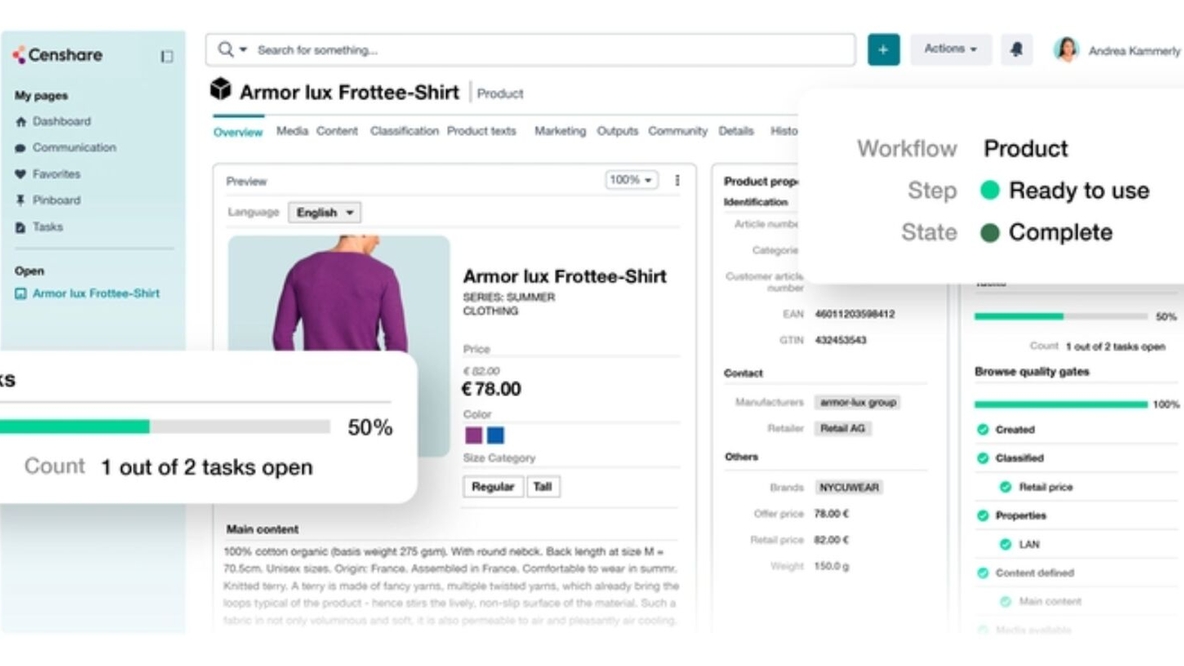
All product data and content — structured attributes, copy, and assets — lives in one centralized system, typically a Product Information Management (PIM) software or a Digital Asset Management (DAM) platform like Censhare. From there, content is distributed to retailers, marketplaces, and digital channels with consistency and speed. Without this foundation, everything else is harder and slower than it needs to be.
Censhare's product view — product content, data, workflow status, and completeness tracking all in a single platform.
Pillar 2: Retailer-Specific Optimization
What works on Amazon won't work identically on Walmart, Instacart, or your own website. A strong strategy adapts content — titles, keywords, image specs, attribute fields — to each retailer's specific requirements and algorithm. This is where the single source of truth pays off: you localize from one master, rather than maintaining parallel versions.
Pillar 3: Continuous Monitoring and Analytics
Digital shelf analytics tools track how your products appear in real time: search rankings, content compliance, review scores, availability, and competitive positioning. This data drives continuous improvement — and catches problems before they cost you sales. Key capabilities to look for include real-time content compliance monitoring, retailer search ranking tracking, review aggregation and sentiment analysis, out-of-stock alerts, and competitive share-of-voice measurement.
This pillar extends beyond external retailer channels. On your own website, monitoring how shoppers are actually searching — which terms return poor results, which searches lead to no clicks — is equally critical. This is where AI-powered on-site search optimization closes the loop between content quality and on-site discovery.
Pillar 4: Cross-Functional Alignment
Digital shelf management is not just an ecommerce problem. It requires alignment across marketing, sales, supply chain, and content operations. Brands that break down these silos — sharing goals, data, and workflows across teams — see measurably better results.
Pillar 5: A Practical Roadmap
For teams getting started, a phased approach works best: assess the current state of your product data and content across all channels, define what "great" looks like for each product category, prioritize by channel impact, build the technology infrastructure, align internal teams, and then iterate continuously. The digital shelf changes fast — quarterly reviews of your digital shelf health should be built into your operating rhythm.
Digital Shelf Management Best Practices: Optimizing Product Listings Across Channels
Managing product listings consistently across multiple retailers and channels is one of the biggest operational challenges in digital shelf management. These are the best practices that make it work at scale.
Centralize your product content and data. All product data and content should originate from one system — a PIM system or DAM system. This is the only way to ensure consistency across retailers without creating duplicate work or introducing errors as your team updates listings manually across platforms.
Use a master template, then localize. Start with a comprehensive product content template that meets your highest content standard, then adapt it for each retailer's specific requirements — character limits, image specs, attribute fields. What you publish on Amazon and what you publish on Walmart will look different, but they should start from the same accurate source.
Automate syndication. Content syndication tools push product data and content directly to retailer portals, removing the need for manual uploads and reducing the risk of errors. The more retailers you sell through, the more essential automation becomes.
Set up product accuracy alerts. Retailers sometimes modify or override your product information without warning. Monitoring tools that flag these changes in real time allow you to correct inaccuracies quickly — before they affect your search rankings or mislead shoppers.
Standardize your product data structure. Attribute names, values, and formats should be consistent across all channels. Inconsistent data structures cause listing errors, incomplete attributes, and poor search performance on retailer platforms.
Check your listings on every retailer, not just your own website. Each retailer has its own requirements for product information — and a product that looks complete on your own site may be missing key attributes on Amazon or Walmart. Those gaps push your products down in retailer search results. Audit each channel separately and fix the biggest gaps first.
Refresh content on a regular cadence. Seasonal updates, new certifications, reformulations, and packaging changes all need to be reflected promptly across every channel. Build a regular content review into your operations so listings never fall behind.
How to Improve Digital Shelf Management and Product Visibility
Product visibility on the digital shelf is about being found — in retailer search results, in Google, and increasingly in AI-powered shopping tools. Here is what drives it.
Optimize for retailer search algorithms. Each major retailer has its own search algorithm with its own ranking factors. Learn them for your key channels and optimize product titles, descriptions, and attributes accordingly — don't assume what works on one platform transfers to another. Retailer search is not the same as Google search, and treating them the same is one of the most common visibility mistakes brands make.
Invest in rich media. Products with multiple high-quality images, video, and enhanced content are more likely to appear higher in retailer search results and more likely to convert when shoppers find them. This is one of the highest-ROI investments a brand can make on the digital shelf.
Build a strong review strategy. Both retailer algorithms and shoppers pay attention to how many reviews a product has and how recent they are. Build a systematic process for soliciting reviews, monitoring sentiment, and responding to customer feedback. Review volume and recency directly affect where your products rank.
Show up in AI-powered search. Tools like Google's shopping features, ChatGPT, and retailer AI assistants are increasingly influencing what shoppers buy before they even visit a product page. Brands that have complete, accurate, well-structured product content are more likely to be surfaced by these tools than those with thin or inconsistent listings.
Keep availability high. Being out of stock removes you from the digital shelf entirely. Monitor inventory levels across channels and act early to prevent stockouts — especially on your highest-visibility products.
Internal vs. External Digital Shelf – What's the Difference and Why Does It Matter?
When brands talk about the digital shelf, they typically focus on external platforms like Amazon or Zalando. But there are actually two distinct digital shelf environments to manage — and the one brands overlook most is often the one they control entirely.
The External Digital Shelf
On external platforms, visibility depends on marketplace algorithms, content quality scores, advertising spend, ratings, and retailer requirements. Brands compete for placement against rivals while adapting to constantly changing platform rules.
This external digital shelf is high-stakes, high-volume, and largely reactive.
The Internal Digital Shelf
Your own ecommerce site is different. Unlike external marketplaces, your internal digital shelf is fully under your control.
By tracking click behavior, search activity, and purchase patterns, brands gain precise insight into how customers navigate their store:
Which products are viewed but not purchased
Where users drop off in the buying journey
Which search queries return poor or no results
Which products drive the highest engagement and conversion
These behavioral signals help optimize every customer touchpoint — from site search and category pages to personalized recommendations, product detail pages, cart experiences, and checkout flows.
The result is a more relevant shopping experience where products are surfaced at the right moment based on real customer intent.
Why the Feedback Loop Matters
What makes modern digital shelf management especially powerful is the continuous feedback loop between customer behavior and product data.
Behavioral insights, conversion signals, and search trends can flow directly back into the PIM system, continuously enriching product information and improving future recommendations, merchandising decisions, and search relevance.
This creates a self-improving internal digital shelf that becomes smarter over time.
Where PIM and Digital Shelf Management Converge
The most advanced enterprise PIM systems now combine structured product data management with behavioral intelligence in a single platform.
Instead of managing product information separately from customer behavior, brands can connect both systems to improve product discoverability, increase conversion rates, and optimize merchandising performance from a centralized source of truth.
When evaluating a digital shelf management platform, this combination matters: centralized product data paired with the ability to act on real customer behavior is what creates a sustainable competitive advantage.
Use Case: How BSH Got Product Information to Shoppers, Faster and More Accurately
BSH Hausgeräte GmbH — the company behind Bosch, Siemens, Gaggenau, and Neff home appliances — sells hundreds of products across more than ten brands in markets all over the world. Getting accurate, compelling product information in front of shoppers in every one of those markets is an enormous content and data challenge.
Before Censhare, BSH's product information and digital assets were spread across multiple disconnected systems — a legacy PIM, a separate text editor, and a media asset management tool that didn't talk to each other. Marketing teams had no visibility into where a piece of content was in the process, or whether it had been approved and published. Product managers responsible for localizing content for their own markets had to navigate complex, difficult-to-use interfaces. And because everything was tied to a product being created in SAP first, marketing could never get ahead of a product launch — they were always working against the clock.
The result on the digital shelf was predictable: product information that was slow to reach shoppers, inconsistent across markets, and difficult to keep accurate as products evolved.
BSH chose Censhare to bring product data and content together in a single, integrated platform — combining PIM and DAM so that product information, images, videos, and marketing copy all lived in one place and flowed through one set of workflows. Crucially, the new approach allowed BSH to build and approve product content before a product was formally ready to launch, rather than scrambling at the last moment. Today, more than 3,000 users across BSH's global markets work within the platform, managing over 11 million assets consistently across all of its brands.
"Attractively presented products turn shopping into an experience and have a lasting effect on purchasing decisions. This applies to both the real and the digital world. A crucial requirement for the highest quality here is efficient and easy-to-use content management." - Joachim J. Reichel, CIO of BSH Read their full story
The operational gains at Steinberg Media Technologies tell the same story in numbers. Steinberg — a global music software company that also uses Censhare to manage its product data and content — previously spent up to four hours publishing a single product update across its website and online shop in multiple languages, using manual copy-paste across disconnected systems. After implementing Censhare as a central content and product data hub, the same update takes five minutes. New products that previously took three days to go live in the online shop are now published in an hour.
"Thanks to Censhare we now have an end-to-end process for our most important channel, our website. All information is entered, processed, approved, structured, where necessary translated and published via Censhare — without a single copy and paste." - Jonas Baumbach, Head of Digital at Steinberg Read their full story
The connection to digital shelf performance is direct: the faster and more reliably accurate your product information reaches your channels, the stronger your position with both shoppers and search algorithms. Outdated content, incomplete attributes, and slow updates all quietly damage your digital shelf presence — often before anyone notices in the sales data. The brands winning on the digital shelf are the ones who've solved the operational problem underneath it.
Benefits of Using AI in Digital Shelf Management
AI is rapidly changing what's possible in digital shelf management — especially for brands managing large, complex product portfolios where manual processes simply can't keep up. Here are the most significant benefits.
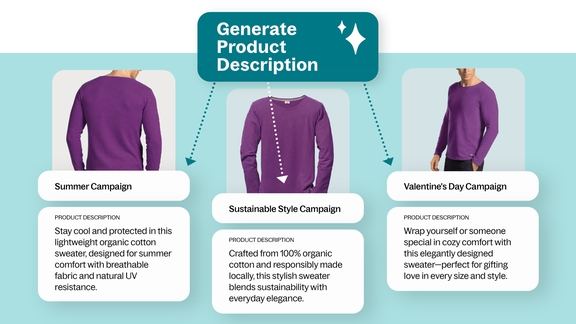
Automated content generation at scale. AI tools can generate and optimize product descriptions, titles, and bullet points across thousands of products — dramatically reducing the time and cost of content production while improving keyword relevance. Human editors review and refine for accuracy and brand voice, but the heavy lifting shifts to the machine.
Product accuracy monitoring. AI can continuously scan retailer sites and flag when product content or data is missing, incorrect, or has been modified by the retailer — catching the kind of product inaccuracy that can quietly damage your search rankings before it shows up in sales data.
Predictive analytics. AI models can identify which products are at risk of losing search visibility before it happens, enabling proactive intervention rather than reactive damage control.
Review analysis. AI can read through thousands of customer reviews and pull out patterns — what shoppers love, what they complain about, what they're comparing you to — far faster than any human team could.
Content testing. AI can test different versions of product content to see which drives more sales across different channels and types of shoppers, and flag what's working.
On-site search optimization. AI tools like Epoq's AI Optimizer analyze how shoppers search on your own website daily, identify terms that return poor results or no clicks, and automatically suggest improvements — so your site search keeps pace with how real shoppers actually search.
For brands competing on the digital shelf at scale, AI isn't optional. It's the difference between a team that's always catching up and one that's consistently ahead.
Where to Find Digital Shelf Management Platforms for Ecommerce
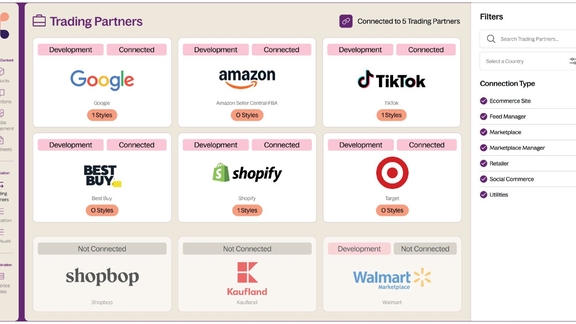
Censhare's Trading Partners view — connecting your product content and data directly to the retailers and channels where shoppers find your products.
Digital shelf management isn't served by a single tool — it's typically supported by a combination of platform types, each covering a different part of the challenge.
Product Information Management (PIM) systemsare the foundation. They centralize your product data — attributes, specifications, descriptions, and relationships — and ensure that accurate information flows to every channel from one source of truth.
Digital Asset Management (DAM) platforms manage the rich media side — product images, lifestyle photography, video, and other visual assets. A DAM ensures the right version of every asset is available to the right team or channel at the right time.
Content syndication tools connect your product content and data directly to retailer portals and marketplaces, automating the distribution process so listings stay accurate and up to date without manual uploads.
Digital shelf analytics platforms give you visibility into how your products are actually appearing across retail channels — tracking search rankings, content completeness, availability, and competitive positioning in real time.
On-site search and personalization tools handle the experience on your own website. Ensuring shoppers can find the right products quickly and that the experience is tailored to what they're actually looking for.
When evaluating platforms, look for solutions that reduce the number of disconnected tools your team has to manage. The more of these capabilities that live in a single integrated platform, the less fragmentation, duplication, and risk of product inaccuracy across your channels.
For brands on the Entirely platform, Censhare and Epoq address all of these needs in an integrated environment. Censhare brings together PIM, DAM, and content syndication — with direct connections to retailers and marketplaces including Amazon, Google, Walmart, Target, TikTok, and Shopify. Epoq handles on-site search optimization and personalization, ensuring shoppers find the right products the moment they land on your website. Together they cover the full digital shelf journey, from content creation to customer discovery.
Ready to take control of your digital shelf? Build a single source of truth with PIM software.
Digital shelf analytics is the process of monitoring and measuring how products appear and perform across online retail channels. It includes tracking search rankings, product content quality, availability, pricing, ratings and reviews, and competitor visibility across marketplaces and ecommerce sites
Digital shelf analytics platforms help brands identify issues that impact discoverability and conversion, such as missing content, inconsistent product data, or poor search placement.
What services exist for creating compelling product descriptions and A+ content?
Brands typically use one of three approaches to create ecommerce product content:
In-house content teams
Specialized ecommerce content agencies
AI-assisted content generation platforms
These services help create product descriptions, enhanced product content, comparison charts, lifestyle imagery, and marketplace-specific assets.
A+ content refers to enhanced product page content on Amazon that goes beyond a standard listing. It often includes rich media, comparison tables, and branded storytelling designed to improve engagement and conversion rates.
Platforms like Censhare help centralize content creation, approval, and distribution across digital channels.
What is the difference between the digital shelf and ecommerce?
Ecommerce refers to the overall process of buying and selling products online.
The digital shelf refers specifically to how products are presented, discovered, ranked, and evaluated across digital channels. This includes product listings, search visibility, product content quality, ratings and reviews, availability, and merchandising placement.
In short:
Ecommerce is the transaction
The digital shelf is the product experience that influences the transaction
Strong digital shelf performance directly impacts ecommerce conversion rates and revenue.
Why is product consistency important for the digital shelf?
Product consistency ensures that product names, descriptions, specifications, pricing, and images remain accurate and aligned across every retailer, marketplace, and ecommerce channel.
Inconsistent product data can:
Confuse shoppers
Reduce trust
Create compliance issues
Hurt search rankings
Lower conversion rates
Centralized product information management (PIM) and digital asset management (DAM) systems help brands maintain consistency at scale.
Platforms like Censhare combine PIM, DAM, and content distribution capabilities within a centralized product content platform.
What is A+ content and does it affect digital shelf performance?
A+ content — also called Enhanced Brand Content on Amazon — is enriched product page content that goes beyond a standard marketplace listing.
It can include:
Enhanced imagery
Product comparison charts
Brand storytelling
Interactive content
Expanded feature descriptions
A+ content is associated with stronger shopper engagement, higher conversion rates, and improved product differentiation on marketplaces like Amazon.
What is the difference between the internal and external digital shelf?
The external digital shelf refers to how products appear on third-party retail platforms such as Amazon or Zalando. Visibility on the external digital shelf is influenced by marketplace algorithms, advertising, retailer requirements, ratings, and product content quality.
The internal digital shelf refers to how products are surfaced, ranked, searched, and recommended within a brand’s own ecommerce site.
Unlike external marketplaces, the internal digital shelf is fully controlled by the brand. It can be optimized using customer behavioral data such as search activity, click behavior, engagement patterns, and conversion trends.
Monica Mahon
Monica Machon ist die Marketing Managerin von censhare US. Sie ist seit 15 Jahren im Marketing tätig. Sie leitet Marketingfunktionen und hilft SaaS-Unternehmen bei der Entwicklung und Umsetzung von Marketingstrategien, Veranstaltungen und Werbeaktivitäten, während sie die Markenpositionierung verbessert und die Umsatzziele beeinflusst.