PIM Implementation: The Practical Guide for Enterprise Teams
If you have made it to this page, you are probably not still asking whether your organization needs a PIM. You already know it does. The question you are actually trying to answer is: what does a successful PIM implementation look like, how long does it take, and what do we need to get it right?
Those are exactly the right questions. PIM implementation is one of those projects that organizations frequently underestimate — not in terms of strategic importance, but in terms of operational complexity. The technology is the straightforward part. The data, the people, the workflows, and the integrations are where implementations succeed or stall.
This guide is built for the teams who are moving from evaluation to execution. It covers every stage of a PIM implementation — from planning and data migration to eCommerce integration, team structure, and measuring ROI — with enough specificity to be genuinely useful, not just directionally correct.
What you will find in this article
What Is PIM Implementation?
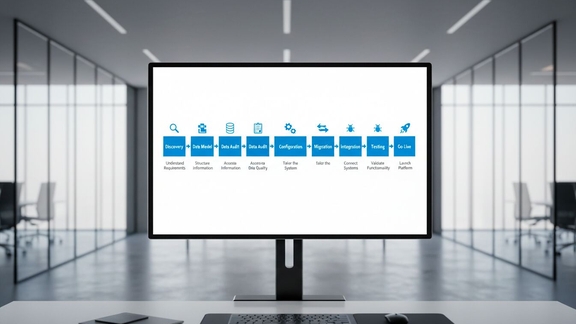
What Are the Essential Steps for a Successful PIM Implementation?
How Long Does a PIM Implementation Usually Take?
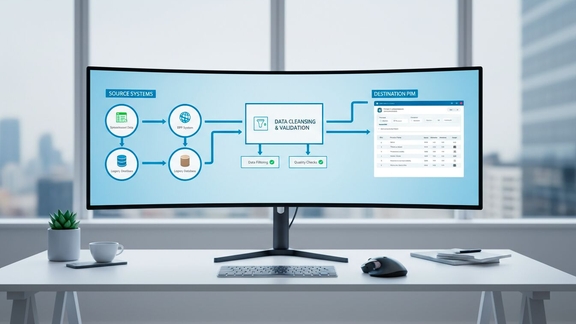
How to Migrate Product Data to a New PIM Platform
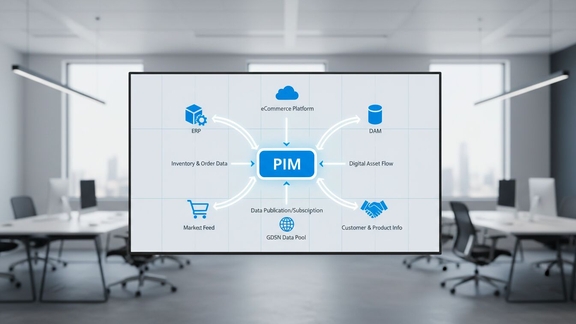
How to Integrate PIM Software With Existing eCommerce Platforms
What Team Roles Are Crucial for a PIM Implementation?
How to Measure the ROI of a PIM Implementation
How Censhare Supports PIM Implementation
FAQ
What Is PIM Implementation?
PIM implementation is the process of deploying a Product Information Management system within an organization — configuring it to match your product data structure, migrating existing data into it, integrating it with your existing technology stack, and establishing the workflows that govern how product content is created, enriched, approved, and distributed going forward.
It is not simply an IT project. A PIM implementation touches product, marketing, eCommerce, legal, and operations teams simultaneously, and its success depends as much on data quality, process design, and change management as it does on technical configuration.
What Is PIM and How Does It Work?
A PIM system is the central repository for all product information in an organization. It stores, structures, and governs the product data that downstream systems — eCommerce platforms, marketplaces, retailer portals, print catalogs, and other channels — consume and display.
At its core, a PIM works by:
Receiving product data from source systems — typically an ERP for core product attributes, and manual or AI-assisted input for marketing content and rich media references.
Structuring that data according to a defined data model — product categories, attribute sets, relationships, and channel-specific variants.
Enabling enrichment — where content teams add descriptions, imagery, compliance information, and channel-specific copy.
Managing approval workflows — routing content through the appropriate review and sign-off stages before publication.
Syndicating the enriched content to downstream channels in the format each channel requires.
Is PIM the Same as ERP?
No — and understanding the distinction is important for anyone planning a PIM implementation.
An ERP (Enterprise Resource Planning) system manages operational business data: inventory, pricing, purchasing, financials, and supply chain. It is the system of record for transactional product data — SKU creation, stock levels, cost pricing — but it is not built to manage the rich, channel-specific content that modern eCommerce and retail require.
A PIM takes the foundational product data from the ERP and builds on it — adding descriptions, imagery, compliance content, localized variants, and channel-specific formatting. The two systems are complementary, not competing. In most enterprise implementations, the ERP is the upstream source of core product data, and the PIM is where that data is enriched and prepared for customer-facing channels.
What Are Examples of PIM Systems?
The PIM market includes a range of platforms suited to different organizational sizes and complexity levels. Enterprise-grade PIM systems — the category relevant to organizations with significant catalog complexity, multiple markets, or omnichannel distribution — include platforms like Censhare, which offers a unified approach that combines PIM, DAM, and CMS capabilities within a single platform, eliminating the integration overhead that comes with managing those functions in separate systems.
What Are the Essential Steps for a Successful PIM Implementation?
A PIM implementation that goes well is almost always one that was planned in detail before any configuration began. The organizations that struggle are typically the ones that treat implementation as primarily a technical exercise, underestimating the data preparation and organizational change required.
Here is the implementation framework that consistently produces the best outcomes:
Phase 1 — Discovery and Requirements Definition
Before any platform is configured, the organization needs a clear picture of what it is building toward. Discovery involves:
Cataloging what you have. How many products? How many attributes per category? How many channels does content need to reach? How many markets and languages?
Mapping your current data flows. Where does product data currently originate? How does it move between systems? Where are the handoffs, the bottlenecks, and the error-prone steps?
Defining what good looks like. What does a complete, high-quality product record look like for each category? What are the required attributes, the optional attributes, and the channel-specific requirements?
Identifying your stakeholders. Who owns product data? Who enriches it? Who approves it? Who publishes it? The answers to these questions directly determine how your workflows will be configured.
Phase 2 — Data Model Design
The data model is the architectural foundation of your PIM. It defines:
Product hierarchy: How products are organized — categories, subcategories, product families, and variants.
Attribute sets: Which attributes exist for each product category, what data type each attribute is, and which are required versus optional.
Relationships: How products relate to each other — parent-child relationships, accessory associations, replacement products.
Channel-specific fields: Attributes that are specific to individual channels — marketplace-specific titles, retailer-specific category codes, market-specific compliance fields.
Getting the data model right is the single most important technical decision in a PIM implementation. A poorly designed data model creates problems that compound over time — as the catalog grows and channels multiply, the structural weaknesses become increasingly expensive to correct.
Phase 3 — Data Audit and Cleansing
Before migrating data into the new PIM, you need to understand the quality of what you are migrating — and address the issues that will cause problems if they travel with the data.
A pre-migration data audit typically surfaces:
Missing required attributes across product categories
Inconsistent formatting — fields that contain the same type of information but formatted differently across records
Duplicate records — multiple entries for the same product with conflicting information
Outdated records — products that are no longer sold but still exist in the source data
Encoding issues — character set problems that cause data to display incorrectly in a new system
Cleaning the data before migration is not optional. Migrating dirty data into a new system does not solve the underlying problems — it relocates them to a more expensive environment.
Phase 5 — Data Migration
With the platform configured and the source data cleaned, migration can begin. Best practice is to migrate in stages rather than attempting a single full-catalog migration:
Pilot migration: Migrate a representative subset of products — typically a single category — and validate the output thoroughly before proceeding.
Category-by-category migration: Migrate the full catalog in category batches, validating each batch before moving to the next.
Post-migration audit: After the full catalog is migrated, run an automated comparison between the source data and the migrated data to confirm completeness and accuracy. m
Phase 6 — Integration
PIM integration with downstream and upstream systems is typically the most technically complex phase of an implementation. Priority integrations include:
ERP integration: Establishing the data flow from the ERP to the PIM for core product attribute synchronization.
eCommerce platform integration: Connecting the PIM to the storefront so that approved product content publishes directly without manual export.
DAM integration: Linking digital asset management so that product records in the PIM are directly connected to the approved assets in the DAM.
Marketplace and channel integrations: Configuring the channel-specific connectors that enable automated syndication.
Phase 7 — Testing and Validation
Before go-live, every aspect of the implementation needs to be tested:
Data quality and completeness in the migrated catalog
Workflow functionality — does content move correctly through every approval stage?
Integration performance — is data flowing correctly between the PIM and connected systems?
Channel output accuracy — is the content being published to each channel correctly formatted and complete?
User acceptance testing — do the teams who will use the system daily find it functional and navigable?
Phase 8 — Go-Live and Hypercare
Go-live is not the end of the implementation — it is the beginning of the operational phase. A structured hypercare period — typically four to eight weeks post-launch — with dedicated support resources, regular check-ins, and a clear escalation path for issues is the difference between a go-live that builds confidence and one that erodes it.
How Long Does a PIM Implementation Usually Take?
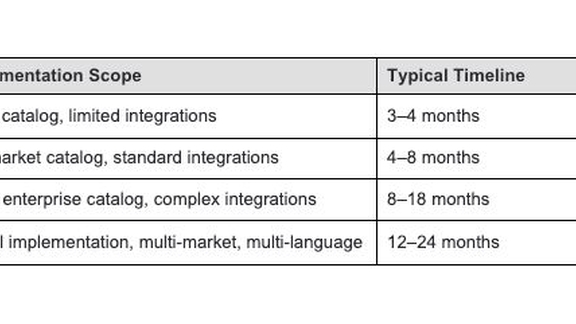
Implementation timelines vary significantly based on catalog size, data quality, integration complexity, and the internal resources available to the project. That said, realistic benchmarks for enterprise implementations are:
The most common causes of timeline extension are:
Data quality issues discovered during the audit phase that require more remediation than anticipated
Data model revisions mid-implementation, when requirements that were not fully defined in discovery surface during configuration
Integration complexity that exceeds initial estimates, particularly for custom or legacy upstream systems
Stakeholder availability — PIM implementations require sustained input from business stakeholders, and when that input is inconsistent, progress stalls
The organizations that complete implementations on schedule are typically the ones that invested the most in the discovery and planning phase — arriving at configuration with clear requirements, clean data, and committed stakeholder involvement.
How to Migrate Product Data to a New PIM Platform
Data migration is the phase of a PIM implementation that carries the most risk and is most frequently underestimated. Here is how to approach it in a way that minimizes that risk: .
Step 1: Complete the data audit first.
Do not begin migration planning until you have a clear picture of what you are migrating: how many records, what data types, what quality issues, what relationships between products.
Step 2: Define the field mapping
Every field in the source system needs to be mapped to its destination in the PIM. Some source fields will map cleanly. Others will need to be split, merged, transformed, or discarded. Document every mapping decision before migration begins.
Step 3: Cleanse at the source.
Address data quality issues in the source system before extraction. This is more efficient than trying to clean data during migration or after it arrives in the new system.
Step 4: Build and test the migration scripts.
Automated migration scripts should be built and tested against a subset of data before running against the full catalog.
Step 5: Run the pilot migration
Migrate a single representative category and validate the output in detail. Does every field populate correctly? Are relationships preserved? Are there encoding issues?
Step 6: Migrate in batches.
Run the full migration category by category, validating each batch before proceeding to the next.
Step 7: Run a parallel period.
or a defined period after migration — typically two to four weeks — maintain the old system alongside the new one. This provides a safety net if issues with the migrated data are discovered post-launch.
Step 8: Decommission the old system.
Once the migrated data has been validated and the operational team is confident in the new system, the old system can be retired.
Best Practices for Migrating Product Data Into a New PIM
Never migrate without a rollback plan. Know exactly how you would revert to the source system if a critical issue is discovered post-migration.
Involve the business, not just IT. The people who know the product data best — category managers, content teams, product specialists — should be involved in validating the migrated data, not just the technical team.
Set a data freeze before migration. Halt updates to the source system during the migration window to prevent data from changing underneath the migration process.
Document every transformation. Every decision to split, merge, or transform a field during migration should be documented, so that any post-migration discrepancy can be traced and understood.
How to Integrate PIM Software With Existing eCommerce Platforms
eCommerce platform integration is typically the highest-priority integration in a PIM implementation, and the one with the most direct commercial impact. When the PIM and the eCommerce platform are correctly integrated, product content that is approved in the PIM publishes automatically to the storefront — no manual export, no copy-paste, no version mismatches.
The integration typically works through one of two mechanisms:
API-based integration. The PIM exposes a content API that the eCommerce platform calls to retrieve product data. This approach is real-time — changes in the PIM are reflected in the storefront without delay — and is the preferred approach for modern, API-first eCommerce platforms.
Feed-based integration. The PIM generates structured data feeds that the eCommerce platform ingests on a scheduled basis. This approach introduces some latency between a PIM update and the storefront reflecting that update, but is often more compatible with older eCommerce platforms that do not support API-based content ingestion.
Key Considerations for eCommerce Integration
Field mapping. The PIM's data model and the eCommerce platform's product schema will not match out of the box. A careful field mapping exercise — defining how every PIM attribute corresponds to a storefront field — is required before integration can be tested.
Image delivery. Product images should be delivered through the integration in the formats and dimensions the eCommerce platform requires. If the PIM is connected to a DAM, this is typically handled through the DAM's asset transformation capabilities.
Inventory and pricing. Inventory levels and pricing typically come from the ERP, not the PIM. The integration architecture needs to be clear about which system is the source of truth for each data type, to avoid conflicts.
Staging and production environments. Integration should be tested thoroughly in a staging environment before connecting to the production storefront.
What Are the Essential Integrations for a PIM System Beyond eCommerce?
ERP
Receive core product data; sync pricing and inventory
DAM
Link product records to approved digital assets
Marketplace Connectors
Syndicate to Amazon, eBay, and other marketplaces
Retailer Portals
Submit product data in retailer-specific formats
GDSN Data Pool
Distribute standardized product data to trading partners via the Global Data Synchronization Network
Translation Management Systems
Route content for localization and receive translated versions
Analytics platforms
Connect content performance data to commercial metrics
Compliance databases
Validate product attributes against regulatory requirements
What Is a GDSN Data Pool and Why Does It Matter?
The Global Data Synchronization Network (GDSN) is an internet-based network of interoperable data pools that enables trading partners — brands, manufacturers, retailers, and distributors — to share standardized, accurate product information in real time. GDSN compliance is required by many major retailers and is increasingly a baseline expectation for organizations distributing products through complex supply chains.
In the context of a PIM implementation, GDSN integration means that approved product data from the PIM can be published directly to the GDSN data pool — typically certified pools like 1WorldSync or Salsify — where trading partners can subscribe to and receive that data in a standardized format. This eliminates the manual data submission processes that many organizations still rely on for trading partner data sharing, and ensures that the product information your partners receive is always current and aligned with your PIM's single source of truth.
What Team Roles Are Crucial for a PIM Implementation?
PIM implementations fail more often because of organizational factors than technical ones. The right team structure — with clear ownership, committed availability, and cross-functional representation — is as important as the right platform.
Executive sponsor. A senior leader who has the organizational authority to make decisions, resolve cross-functional conflicts, and keep the project resourced appropriately. Without executive sponsorship, PIM implementations frequently stall when competing priorities emerge.
Project manager. Responsible for the implementation timeline, workstream coordination, stakeholder communication, and issue escalation. This role should be dedicated — not someone managing the implementation as a secondary responsibility.
Data architect / data manager. The person responsible for designing the data model, defining the migration approach, and ensuring data quality throughout the implementation. This role requires both technical capability and deep knowledge of the organization's product data.
Business analyst. Responsible for translating business requirements into system configuration — defining workflows, attribute sets, user roles, and channel mapping in terms the implementation team can act on.
IT / integration lead. Responsible for the technical integration work — connecting the PIM to the ERP, eCommerce platform, DAM, and other systems. This role needs to understand both the PIM's integration capabilities and the APIs of the connected systems.
Content team lead. Representing the teams who will use the PIM daily — product managers, content writers, category managers — to ensure that the system is configured in a way that works for the people who will operate it.
Change management lead. Responsible for training, documentation, and the organizational change program that ensures adoption after go-live. Frequently under-resourced, and frequently one of the primary reasons post-go-live adoption falls short of expectations.
How to Measure the ROI of a PIM Implementation
ROI measurement for a PIM implementation should begin before the project starts — by establishing baseline metrics that you will measure against post-implementation. Organizations that skip this step often find themselves unable to demonstrate the value of the investment, even when the operational improvements are significant.
The most meaningful ROI metrics fall into four categories:
Operational Efficiency
Time-to-publish for new SKUs: How long does it take from a product being created in the ERP to it being live and accurate across all channels? Measure before and after implementation.
Hours spent on manual data reformatting and syndication: Track the time your team currently spends on manual channel submission and reformatting. Post-implementation, this should drop significantly.
Content completeness score: What percentage of required attributes are populated across your catalog? This should improve measurably as the PIM enforces completeness at the point of entry.
Commercial Impact
Return rate by product category: A meaningful portion of product returns are content problems — customers receiving a product that does not match the description or imagery they relied on. Measure return rates by category before and after implementation.
Revenue from new channel launches: Post-implementation, how quickly can your team launch a new channel or market? The reduction in time-to-market for new channels represents direct incremental revenue opportunity.
Data Quality
Error rate in published product content: How frequently is inaccurate or incomplete product content identified post-publication? This should decline as the PIM's validation rules prevent poor data from being published.
Channel consistency score: What percentage of your product records are consistent across all channels where they appear? Measure before and after.
Cost Avoidance
Compliance remediation cost: For organizations in regulated industries, content compliance errors have direct financial consequences. A PIM that prevents those errors avoids those costs.
Headcount efficiency: The right PIM implementation allows your catalog and channel complexity to grow without proportional increases in headcount. Track the ratio of SKUs managed per content team member before and after implementation.
How Censhare Supports PIM Implementation
Censhare's approach to PIM implementation is built around a unified content platform that brings product information management, digital asset management, and content management together in a single environment. For organizations planning an implementation, this matters for a practical reason: the integration overhead that comes with connecting a standalone PIM to a separate DAM and CMS is eliminated from the outset.
For the teams doing the implementation work:
For the IT and integration lead managing a complex technology stack: Censhare's flexible integration layer supports both standard connectors — eCommerce platforms, ERP systems, GDSN data pools, marketplace APIs — and custom integration development for legacy systems that do not have pre-built connectors.
For the data architect designing a data model for a large and complex catalog: Censhare's data model is built to handle enterprise-scale complexity — multiple product hierarchies, market-specific variants, multi-language content, and compliance-specific attribute sets — without requiring workarounds.
For the content and operations teams who will use the system daily: Censhare's workflow engine supports configurable approval processes that can be tailored to the organization's specific governance requirements — from a simple two-step review to a multi-stage, multi-market approval chain.
For the executive sponsor evaluating whether the investment is justified: Censhare is deployed by global enterprise organizations across retail, manufacturing, food and grocery, media, and QSR — organizations with the catalog complexity and channel demands that make a unified content platform necessary, not optional.
A PIM implementation is one of the highest-leverage investments a product-led organization can make. When it is done well — with the right planning, the right team structure, clean data, and a platform built for enterprise complexity — it compresses time-to-market, reduces return rates, improves channel consistency, and creates the operational foundation that allows the business to scale without scaling its content problems alongside it.
The organizations that get the most from their PIM implementation are the ones that treat it as an organizational transformation, not just a technology deployment. The platform is the enabler. The data model, the workflows, the integrations, and the people who use the system every day are what determine the outcome.
If you are at the stage where the strategic case is made and the operational questions are what remain, we are built for exactly that conversation.
PIM implementation is the process of deploying a Product Information Management system — configuring it to match your product data structure, migrating existing data into it, connecting it to your technology stack, and establishing the workflows that govern how product content is created, enriched, approved, and distributed going forward. It is not a purely technical project. A successful PIM implementation requires cross-functional involvement from product, marketing, eCommerce, legal, and operations teams, and depends as much on data quality, process design, and organizational change management as it does on platform configuration.
How do I start a PIM implementation?
The most important first step is a thorough discovery phase — before any platform is configured or any data is migrated. Discovery means cataloging your existing products, channels, markets, and data flows; defining what a complete, high-quality product record looks like for each category; identifying your key stakeholders and their roles in the content lifecycle; and documenting the integration requirements between the PIM and the systems it needs to connect to. Organizations that invest in a rigorous discovery phase consistently complete implementations faster and with fewer costly mid-project revisions than those that move too quickly to configuration.
How long does a PIM implementation usually take?
Enterprise PIM implementations typically take between 6 and 18 months, depending on catalog size, data quality, integration complexity, and internal resource availability. Small catalog implementations with limited integrations can be completed in 3–4 months. Large, multi-market, multi-language implementations with complex integration requirements can take 12–24 months. The most common cause of timeline extension is data quality issues discovered during the audit phase — which is why investing in a thorough data audit and cleanse before migration begins is one of the highest-return activities in any PIM implementation.
What are the key benefits of implementing a PIM?
The key benefits of a PIM implementation are: faster time-to-market for new products, as structured enrichment workflows and automated syndication replace manual processes; reduced return rates, as complete and accurate product content sets better customer expectations before purchase; improved channel consistency, as a single source of truth ensures the same accurate content reaches every channel simultaneously; lower operational cost, as manual reformatting and data re-entry are eliminated; and a scalable content infrastructure that allows catalog and channel complexity to grow without proportional increases in headcount.
What team roles are crucial for a PIM implementation?
A successful PIM implementation requires an executive sponsor with organizational authority, a dedicated project manager, a data architect responsible for the data model and migration approach, a business analyst to translate requirements into system configuration, an IT or integration lead for the technical connection work, a content team representative ensuring the system works for daily users, and a change management lead to drive training and adoption. The change management role is the most frequently underresourced — and one of the most common contributors to post-go-live adoption challenges.
How to integrate PIM software with existing eCommerce platforms?
PIM integration with eCommerce platforms typically works through an API-based connection — where the eCommerce platform calls the PIM's content API to retrieve approved product data in real time — or a feed-based integration where the PIM generates structured data feeds that the platform ingests on a scheduled basis. API-based integration is preferred for modern platforms and real-time consistency. The key technical requirements are field mapping between the PIM and the platform's product schema, image delivery configuration, and clarity about which system owns pricing and inventory data. Integration should always be tested thoroughly in a staging environment before connecting to production.
How to measure the ROI of a PIM implementation?
ROI measurement requires establishing baseline metrics before implementation begins. The most meaningful metrics are: time-to-publish for new SKUs, hours spent on manual reformatting and syndication, product return rates by category, conversion rates on product detail pages, content completeness score, channel consistency score, and the ratio of SKUs managed per content team member. Post-implementation, improvements in these metrics can be translated directly into financial terms — revenue from faster time-to-market, cost avoided through reduced returns, and labor cost saved through automation.
What is a GDSN data pool?
GDSN stands for Global Data Synchronization Network — an internet-based network that enables brands, manufacturers, retailers, and distributors to share standardized product information with trading partners in real time. In the context of a PIM implementation, GDSN integration means that approved product data from the PIM is published directly to a certified GDSN data pool — such as 1WorldSync — where trading partners can subscribe to and receive that data in a standardized format. GDSN compliance is increasingly a baseline expectation for organizations distributing products through major retail supply chains.
Chris Leaman
Chris Leaman hat über zehn Jahre Erfahrung als Solution Architect in den Bereichen Business Process Management, Marketing Resource Management, Digital Asset Management, Web/Content Management und Marketing Automation in einer kundenorientierten Rolle. Bevor er zu Emmsphere Plus kam, verwaltete er das DAM eines großen Einzelhändlers und war an der Umstellung auf ein neues System beteiligt.